This blog was written by experts by experience Jack, Anna and Ella, with support from Professor Kamaldeep Bhui, a member of MQ's Science Council.
I am Jack, and I work as research and policy advisor for the ATTUNE Research project.
One out of every five young people aged 10-25 is experiencing a mental health problem; this is a terrifying statistic, especially when we consider there are 12 million young people in this age bracket in the UK.. What is even more worrying, is that during this crucial time in their life where their identity and their personality develop, over half of those have not had effective support.
Another staggering number is that mental health costs the UK conservatively £117.9 billion every single year. Adverse childhood experiences (ACEs) that the young people experience can have life long and life-limiting effects. Young people who have ACEs are more likely to consider suicide, use alcohol and drugs, develop chronic illnesses, and face unemployment.
Having more than 5 ACEs is suggested to shorten life expectancy by 15-20 years.
Although ACEs can affect anyone, those who live in the poorest parts of the country, or who are part of minority communities like the LGBTQIA+ community, immigrant community, those who are neurodivergent and disabled, and others not accessing support are more likely to suffer, and more vulnerable to experiencing and being affected by ACEs.
Working with the ATTUNE Project as part of their Young People Advisory Groups (YPAGs), I have been able to see how ACEs can have a catastrophic effect on young people and their lives. Across the country the stories that I have heard are so different, but similar too in terms of invalidation of experience, and the strong feeling that their experiences do not matter to those who are meant to be helping them. This not only damages the possibility that young person reach out for support but can be an ACE in of itself. I have also been able to see how effective ways creative practice works in helping young people to process, open up and communicate with others about things which are bothering them.
A group of us spoke to a Youth Worker in Cornwall about his experiences working with young people who are experiencing poor mental health. He spoke of how he offers them a choice for the sessions he does with them, either go out and do an activity and talk, or stay inside; all of them, he said, chose to do an activity. This aligns with one of the project’s findings, which has consistently come up in the research, that is the importance for young people of nature, whether viewing it from a distance, or experiencing being in green spaces or near the sea.
The idea of a third space (a safe space away from home and school/work) is also something that has been commonly brought up in the research by young people as a crucial element for youth mental health. Creative arts, and spaces for young people just two of the elements which are solutions for helping young people in their mental health.

The system itself also needs changing, many of the services that currently work for young people do not provide an effective response, due to lack of capacity, underfunding, and many other reasons. Having trauma informed approaches being more widespread in the school and workplace, having more community safe spaces like Youth Cafes, having defined minimum standards of mental health training for positions involved with young people, and overhauling mental health services for young people would be the very start to help prevent adverse childhood experiences from affecting young people throughout their life.
It is so important to have young people involved in these decisions, as being able to co-design we can feel that our experiences and voices are being listened to as decisions are being made about our care and our futures. To have one in every five young people experiencing poor mental health is indicative of just how critically the system is desperately failing young people, and how much we need it to change.
Preventive Action
Prevention is the way forward, alongside IMPROVING existing support.
- For every $1 invested in the full set of interventions, we expect $24 in health and economic benefits to be returned to the economy over the course in the long term.
- The interventions with the highest ROIs are the treatment of mild depression and school-based prevention of anxiety and depression.
There is evidence for shorter term cost effectiveness for the following interventions:
- Training health visitors to identify women at risk of perinatal depression and providing psychological therapies for those at risk
- Evidence-based parenting programmes
- Anti-bullying programmes in schools
- Exercise for all children, young people, and adults
- Identifying adults at risk of poor mental health early and providing psychosocial support (remote or face-to-face)
- Identifying mental health difficulties in the workplace and providing psychological support and change work cultures
- Suicide prevention measures
If we have this evidence, why is there not more preventive action?
We need prevention leadership, for example, the Royal College of Psychiatrists has launched a new leadership in public health course, bringing together and growing capacity in the health and social care workforce and to promote prevention. We need better leadership and influencing skills for systems change, including the public and professionals working in partnership within health and social care, local authorities, schools, all public services and employing organisations.

Ella's story
Teachers are often not appropriately informed or aware of pupils' needs. I had to have a pass to leave classrooms if I was having a panic attack, but many teachers were unaware of this and questioned me or didn't let me use it.
My younger sibling has missed a lot of school due to health issues and has been provided no catch-up work but is consistently told he is missing his target grades.
Too much focus is put on grades and exams, and not enough on encouraging students to learn.
CAHMS is not fit for purpose (although I'm sure everyone is aware of that!). I was told my mental health wasn't "bad enough" for help through the NHS, so I went home, and my mental health got worse! I had to seek private therapy.
Valuable years are lost. This is unethical, wasteful, unprofessional yet is the current state of policy and practice, with waiting lists extending into years, specialist services with very hight thresholds for acceptance; we need greater capacity and better skills in primary care and schools and the community for supporting adolescents.
Protections in the first 1000 days and into adolescence are essential; physical activities, friendships, less noise, and better air quality, housing, nutrition and more safe spaces can all help. Creative arts methods enable access to support for those with alternative learning styles or communication and emotional needs which are not easily addressed in verbally orientated care practices.
Parents and teachers need to attune to the support needs of young people who have experienced ACEs and must also be supported in these emotionally demanding roles. We need schools and public services to be more socio-emotionally informed learning environments. Schools can become public health spaces and venues for communities, bringing local authority supports to a friendlier and familiar place.
Young people need more skills in managing their lives, self-care, budgeting, work experience and independent living. Employers all need to have trauma informed practices and policies. Generally, we must get it right the first time as otherwise young people feel further marginalised and rejected, making it harder to seek support again but also suffering more due to invalidation itself. Alongside teachers, we need to strengthen the workforce, for example, social workers are needed but there are insufficient in care systems, in mental health care and in schools. They are a valuable support for safeguarding and social interventions closer to people’s lives and for family work.

Read more about MQ's calls for a national trauma strategy.
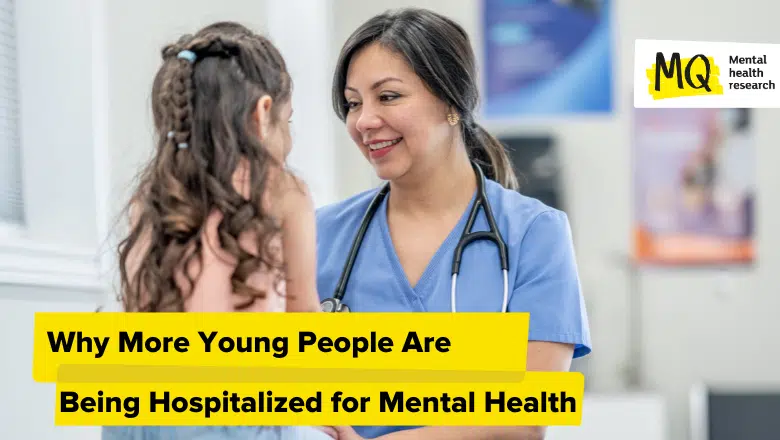
In the last decade there has been a 65% increase in children and young people being admitted to hospital with a mental health issue.